Geen evolutie en ecolutie zonder revolutie!

Albert Einstein:

Twee dingen zijn oneindig: het universum en de menselijke domheid. Maar van het universum ben ik niet zeker.

donderdag 17 januari 2019

Massamedia verantwoordelijk voor doden onder klanten

In de VS spreekt men n.a.v. de Trump administratie over 'Trump Hypersensitive Unexplained Disorder' (THUD), een aandoening die wordt veroorzaakt door het regeringsbeleid van Trump, uiteraard dik gerelateerd aan de leugen die men 'Russiagate' noemt....... Mensen die aan deze aandoening lijden hebben last van een groot aantal symptomen, zoals: overeten, hoofdpijn, flauwvallen, chronische nekpijn, depressie en zelfs suikerproblemen plus hartklachten...... (voor een volledige lijst, zie het hieronder opgenomen artikel van Caitlin Johnstone)

Aan voorgaande aandoeningen lijdt men in de VS al decennia lang, niet zo vreemd als je ziet hoe inhumaan men daar met het grote arme deel van de bevolking omgaat, -hoe men omgaat met wapenbezit, -hoe men omgaat met kleurlingen, -hoe men de ene na de andere illegale oorlog voert, -de enorme prestatiedwang in de VS maatschappij en zaken als -de prijs voor gezonde voeding (arme gezinnen zijn altijd goedkoper uit als ze eten halen bij zaken als McDonald's, i.p.v. gezonde voeding uit de winkel of van de markt).... 

Buiten wapenbezit, zijn deze zaken overigens ook van toepassing op veel andere westerse bevolkingen, zelfs in Nederland lijden veel mensen aan de hiervoor benoemde gezondheidsklachten......

Johnstone betoogt terecht dat de reguliere massamedia verantwoordelijk zijn voor doden, niet alleen met hun onvoorwaardelijke steun aan het oneindig illegaal oorlogvoeren door de VS, maar ook voor het bewaren (en bewaken) van de ijskoude, inhumane neoliberale status quo, door deze dag in dag uit als zaligmakend te prediken..... Daarmee propageren deze media de klassenmaatschappij die van nooit weggeweest weer massaal wordt omarmt in de VS (en andere westerse landen), ja zelfs door mensen die arm zijn, daar de media hen voorhouden dat ze volgend jaar wel eens schathemelrijk zouden kunnen zijn.... Ofwel het inleveren van de leugen dat het leven na de dood veel beter zou zijn dan het leven zelf, zoals o.a. door christenen gepropageerd, wordt meer en meer ingewisseld voor het gehersenspoelde 'kansdenken', waarvoor de reguliere massamedia en veel politici verantwoordelijk zijn.....

Vergeet niet dat je in de VS aanwijsbaar langer kan leven als je geld hebt, buiten de (gedwongen) voedselkeuze voor arme burgers, is ook de medische hulpverlening voor de welgestelden tientallen procenten beter dan die voor de grote onderlaag van arme mensen in de VS, van wie niet zelden mensen vroegtijdig overlijden aan bijvoorbeeld kanker, daar ze de therapieën niet kunnen betalen....... Buiten de 50 miljoen VS burgers die afhankelijk zijn van voedselbonnen, zijn er vele miljoenen meer, die zelfs met 2 banen niet rond kunnen komen (een zaak die hier ook meer en meer voorkomt, we volgen de VS dan ook in het asociale neoliberale VS beleid.......)

Mainstream Media Is Now Killing People Directly


new, updated data set is now available on a psychological phenomenon that has been labeled "Trump Anxiety Disorder" or "Trump Hypersensitive Unexplained Disorder," and it says that the phenomenon only got worse in 2018. The disorder is described as a specific type of anxiety in which symptoms "were specific to the election of Trump and the resultant unpredictable sociopolitical climate," and according to the 2018 surveys Americans are feeling significantly more stressed by the future of their country and the current political environment than they were last year.

Pacific Standard reports as follows:

As the possibility of a Hillary Clinton victory began to slip away—and the possibility of a Donald Trump presidency became more and more certain—the contours of the new age of American anxiety began to take shape. In a 2017 column, Washington Postcolumnist Dana Milbank described this phenomenon as "Trump Hypertensive Unexplained Disorder":

"Overeating. Headaches. Fainting. Irregular heartbeat. Chronic neck pain. Depression. Irritable bowel syndrome. Tightness in the chest. Shortness of breath. Teeth grinding. Stomach ulcer. Indigestion. Shingles. Eye twitching. Nausea. Irritability. High blood sugar. Tinnitus. Reduced immunity. Racing pulse. Shaking limbs. Hair loss. Acid reflux. Deteriorating vision. Stroke. Heart attack. It was a veritable organ recital".

Two years later, the physiological effects of the Trump administration aren't going away. A growing body of research has tracked the detrimental impacts of Trump-related stress on broad segments of the American population, from young adults to women, to racial and LGBT communities.

The results aren't good.

“A growing body of research tracked the detrimental impacts of Trump-related stress on broad segments of the American population, from young adults to women, to racial and LGBT communities.” @jaredbkeller on the biological response to living under Trump. https://bit.ly/2TRhIWF 

Research Suggests Trump's Election Has Been Detrimental to Many Americans' Mental Health

Particularly that of the country's most marginalized groups.
psmag.com


I do not for one second doubt that Americans are feeling more stressed and suffering more health-degrading symptoms as a result than they were prior to Trump's election. But Pacific Standard and its "growing body of research" ignore the most obvious and significant culprit behind this phenomenon which is tearing people's health to shreds: the mass media which has been deliberately fanning the flames of Trump panic.

The always excellent Moon of Alabama blog has just published a sarcasm-laden piecedocumenting the many, many aggressive maneuvers that this administration has made against the interests of Russia, from pushing for more NATO funding to undermining Russia's natural gas interests to bombing Syria to sanctioning Russian oligarchs to dangerous military posturing. And yet the trending, most high-profile stories about Trump today all involve painting him as a Putin puppet who is working to destroy America by taking a weak stance against an alarming geopolitical threat. This has had the effect of manufacturing demand for even more dangerous escalations against a nuclear superpower who just so happens to be a longtime target of US intelligence agencies.

If the mass media were in the business of reporting facts, there would be a lot less "Putin's puppet" talk and a lot more "Hey, maybe we should avoid senseless escalations which could end all life on earth" talk among news media consumers. But there isn't, because the mass media is not in the business of reporting facts, it's in the business of selling narratives. Even if those narratives are so shrill and stress-inducing that they imperil the health of their audience.

Trump is clearly not a Russian asset, he's a facilitator of America's permanent unelected government just like his predecessors, and indeed as far as actual policies and administration behavior goes he's not that much different from Barrack Obama and George W Bush. Hell, for all his demagogic anti-immigrant speech Trump hasn't even caught up to Obama's peak ICE deportation years. If the mass media were in the business of reporting facts, people would be no more worried about this administration than they were about the previous ones, because when it comes to his administration's actual behavior, he's just as reliable an upholder of the establishment-friendly status quo as his predecessors.

(mijn excuus, deze afbeelding past niet helemaal op de pagina, krijg het niet op orde, voor de volledige lijst zie Caitlin Johnstone of klik op de afbeelding)

Used to be that the US mass media only killed people indirectly, by facilitating establishment war agendas in repeating government agency propaganda as objective fact and promulgating narratives that manufacture support for a status quo which won't even give Americans health insurance or safe drinking water. Now they're skipping the middle man and killing them directly by psychologically brutalizing them so aggressively that it ruins their health, all to ensure that Democrats support war and adore the US intelligence community.

They do this for a reason, of course. The Yellow Vests protests in France have continued unabated for their ninth consecutive week, a decentralized populist uprising resulting from ordinary French citizens losing trust in their institutions and the official narratives which uphold them. The social engineers responsible for controlling the populace of the greatest military power on the planet are watching France closely, and understand deeply what is at stake should they fail to control the narrative and herd ordinary Americans into supporting US government institutions. Right now they've got Republicans cheering on the White House and Democrats cheering on the US intelligence community, but that could all change should something happen which causes them to lose control over the thoughts that Americans think about their rulers.

Propaganda is the single most overlooked and under-appreciated aspect of human society. The ability of those in power to manipulate the ways ordinary people think, act and vote has allowed for an inverted totalitarianism which turns the citizenry into their own prison wardens, allowing those with real power to continue doing as they please unhindered by the interests of the common man.

The only thing that will lead to real change is the people losing trust in corrupt institutions and rising like lions against them. That gets increasingly likely as those institutions lose control of the narrative, and with trust in the mass media at an all-time low, populist uprisings restoring power to the people in France, and media corporations acting increasingly weird and insecure, that looks more and more likely by the day.
_________________________
The best way to get around the internet censors and make sure you see the stuff I publish is to subscribe to the mailing list for my website, which will get you an email notification for everything I publish. My articles are entirely reader-supported, so if you enjoyed this piece please consider sharing it around, liking me on Facebook, following my antics on Twitter, throwing some money into my hat on Patreon or Paypalpurchasing some of my sweet new merchandise, buying my new book Rogue Nation: Psychonautical Adventures With Caitlin Johnstone, or my previous book Woke: A Field Guide for Utopia Preppers.

Bitcoin donations:1Ac7PCQXoQoLA9Sh8fhAgiU3PHA2EX5Zm2

Caitlin Johnstone | January 16, 2019 at 2:35 am |


Tags: #TrumpmediaMSMpropaganda | Categories: Article | URL: https://wp.me/p9tj6M-1vG

woensdag 16 januari 2019

Petra van Haren (AVS) is tegen de onderwijsstaking op 15 maart a.s.......

Afgelopen zaterdag in het suffe Nieuwsweekend (Radio1) van omroep MAX, Petra van Haren, voorzitter van de Algemene Vereniging Schoolleiders (AVS).

Hier liet van Haren weten dat ze tegen de onderwijsstaking is op 15 maart a.s., een staking waartoe de Algemene Onderwijsbond (AOb) het gehele onderwijs oproept...... Hoe is het mogelijk dat iemand die de ellende in het onderwijs beter dan wie kan overzien, tegen een staking is, terwijl de verantwoordelijk minister van Engelshoven, NB van 'onderwijspartij' D66 heeft laten weten dat er geen cent bijkomt voor het onderwijs......... Het voorgaande ondanks een groot tekort aan leraren, daardoor overbelaste onderwijzers en schoolleiders die met de handen in het haar zitten...... Schoolleiders waaraan, als bij de gewone leerkrachten, een groot tekort bestaat......

Nee, van Haren wil eerst doorgaan met de onderhandelingen, terwijl van Engelshoven over meer geld naar onderwijs, het belangrijkste punt van de onderhandelingen, geen twijfel laat bestaan, zoals gezegd een groot en dik NEE!!

Ook het moment waarop vindt van Haren geheel verkeerd: vlak voor de Staten verkiezingen...... ha! ha! ha! ha! ha! Het is dan ook wel duidelijk: van Haren komt uit het 'christelijk onderwijs' en zal ongetwijfeld lid zijn van ofwel het CDA dan wel de 'Christen'Unie......

Wel wil de voorzitter van de Algemene Vereniging Schoolleiders meewerken aan ontruimingsalarmen van scholen door het hele land, een gepast protest aldus de disfunctionerende voorzitter van Haren.......

Jarenlang wordt er al overlegd met de onderwijsbonden en al even lang blijft de ellende bestaan, wat zeg ik, de ellende neemt alleen maar toe, daar veel onderwijzend personeel vergrijst en in steeds grotere aantallen met pensioen gaat...... Waar haalt van Haren het gore lef vandaan om te zeggen dat ze eerst wil praten, voordat er gestaakt gaat worden.......

Ik wed zomaar, dat de schoolleiders en het onderwijzend personeel op z'n zachtst gezegd niet blij zijn met van Haren.......

Ongelofelijk!!

Onderwijzend personeel sluit je aan bij de staking van 15 maart a.s. en geeft het door!!!

PS: we leven intussen al lang weer in een klassenmaatschappij en zo zijn er al een groot aantal privéscholen (of: particulier onderwijs), daar geen gebrek aan geld en onderwijzend personeel >> een schunnige situatie die is ontstaan door wanbeleid van de VVD, D66, het CDA, de PvdA en de ChristenUnie........

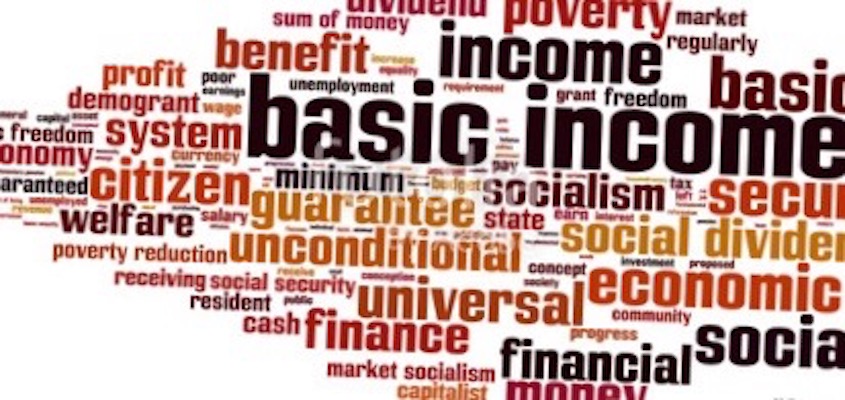
Basisinkomen en geluk: een doel voor de hele mensheid

Black Agenda Report bracht vorige week woensdag een artikel, eerder gepubliceerd op Truthdig en geschreven door Ellen Brown, waarin zij betoogt dat een universeel basisinkomen (UBI) geen probleem is en niet ten koste zal gaan van belastingverhogingen voor de hogere of de middeninkomens. 

Het betreft hier een uiterst intelligent schrijven van Brown, een artikel dat van groot belang kan zijn voor iedereen op onze kleine aarde: het uitroeien van armoede en een oplossing voor de tijd dat machines en computers het overgrote deel van de arbeid die de mens verricht zullen overnemen. 

Praatjes dat de automatisering alleen maar meer banen zullen opleveren, zijn volkomen naast de waarheid...... Neem de betaalautomaten: deze automaten hebben duizenden bankmedewerkers de baan als loketmedewerker gekost..... Of wat dacht je van de automatisering in de landbouw, werk dat vroeger door tienduizenden arbeiders werd gedaan, kan nu in veel gevallen zelfs met 2 machines worden verricht, het in de grond stoppen van zaden en de oogst...... 

Met een basisinkomen kunnen we eindelijk aan het geluk van de mens werken, wel zal men daarvoor in het onderwijs ruimte vrij moeten maken voor lessen hoe om te gaan met vrije tijd, iets waar mensen niet goed in zijn en waar de meesten van ons pas achter komen bij werkloosheid en na pensionering..... (en dat is toch uitermate triest...)

Lees het volgende artikel en geeft het door:


Universal Basic Income Is Easier Than It Looks

Universal Basic Income Is Easier Than It Looks
Ellen Brown 09 Jan 2019
A universal income program can help correct the debt bubble problem without fear of “overheating” the economy.

It could actually be funded year after year without driving up taxes or prices.”

Calls for a Universal Basic Income (UBI) have been increasing, most recently as part of the “Green New Deal” (GND) introduced by Rep. Alexandria Ocasio-Cortez, D-N.Y., and supported in the last month by at least 40 members of Congress. A UBI is a monthly payment to all adults with no strings attached, similar to Social Security. Critics say the Green New Deal asks too much of the rich and upper-middle-class taxpayers who will have to pay for it, but taxing the rich is not what the resolution proposes . It says funding would primarily come from the federal government, “using a combination of the Federal Reserve, a new public bank or system of regional and specialized public banks,” among other vehicles.
The Federal Reserve alone could do the job. It could buy “Green” federal bonds with money created on its balance sheet, just as the Fed funded the purchase of $3.7 trillion in bonds in its “quantitative easing” program to save the banks. The Treasury could also do it. The Treasury has the constitutional power to issue coins in any denomination, even trillion dollar coins . What prevents legislators from pursuing those options is the fear of hyperinflation from excess “demand” (spendable income) driving prices up. But in fact the consumer economy is chronically short of spendable income, due to the way money enters the consumer economy. We actually needregular injections of money to avoid a “balance sheet recession” and allow for growth, and a UBI is one way to do it.
Funding would primarily come from the federal government, “using a combination of the Federal Reserve, a new public bank or system of regional and specialized public banks,”
The pros and cons of a UBI are hotly debated and have been discussed elsewhere . The point here is to show that it could actually be funded year after year without driving up taxes or prices.New money is continually being added to the money supply, but it is added as debt created privately by banks. (How banks, rather than the government, create most of the money supply today is explained on the Bank of England website here .) A UBI would replace money-created-as-debt with debt-free money—a “debt jubilee” for consumers—while leaving the money supply for the most part unchanged; and to the extent that new money was added, it could help create the demand needed to fill the gap between actual and potential productivity.
The Debt Overhang Crippling Economies
The “bank money” composing most of the money in circulation is created only when someone borrows, and today businesses and consumers are burdened with debts that are higher than ever before. In 2018, credit card debt alone exceeded $1 trillion, student debt exceeded $1.5 trillion, auto loan debt exceeded $1.1 trillion, and non-financial corporate debt hit $5.7 trillion. When businesses and individuals pay down old loans rather than taking out new loans, the money supply shrinks, causing a “balance sheet recession.” In that situation, the central bank, rather than removing money from the economy (as the Fed is doing now), needs to add money to fill the gap between debt and the spendable income available to repay it.
Debt always grows faster than the money available to repay it. One problem is the interest , which is not created along with the principal, so more money is always owed back than was created in the original loan. Beyond that, some of the money created as debt is held off the consumer market by “savers” and investors who place it elsewhere, making it unavailable to companies selling their wares and the wage-earners they employ. The result is a debt bubble that continues to grow until it is not sustainable and the system collapses, in the familiar death spiral euphemistically called the “business cycle.” As economist Michael Hudson shows in his 2018 book, “… and Forgive Them Their Debts ,” this inevitable debt overhang was corrected historically with periodic “debt jubilees”—debt forgiveness—something he argues we need to do again today.
For governments, a debt jubilee could be effected by allowing the central bank to buy government securities and hold them on its books. For individuals, one way to do it fairly across the board would be with a UBI.
Why a UBI Need Not Be Inflationary
In a 2018 book called “The Road to Debt Bondage: How Banks Create Unpayable Debt ,” political economist Derryl Hermanutz proposes a central-bank-issued UBI of $1,000 per month, credited directly to people’s bank accounts. Assuming this payment went to all U.S. residents over 18, or about 250 million people, the outlay would be about $2.5 trillion annually. For people with overdue debt, Hermanutz proposes that it automatically go to pay down those debts. Since money is created as loans and extinguished when they are repaid, that portion of a UBI disbursement would be extinguished along with the debt.
People who were current on their debts could choose whether or not to pay them down, but many would also no doubt go for that option. Hermanutz estimates that roughly half of a UBI payout could be extinguished in this way through mandatory and voluntary loan repayments. That money would not increase the money supply or demand. It would just allow debtors to spend on necessities with debt-free money rather than hocking their futures with unrepayable debt.
He estimates that another third of a UBI disbursement would go to “savers” who did not need the money for expenditures. This money, too, would not be likely to drive up consumer prices, since it would go into investment and savings vehicles rather than circulating in the consumer economy. That leaves only about one-sixth of payouts, or $400 billion, that would actually be competing for goods and services; and that sum could easily be absorbed by the “output gap” between actual and forecasted productivity.
$2 trillion could be injected into the economy every year without creating price inflation.”
According to a July 2017 paper from the Roosevelt Institute called “What Recovery? The Case for Continued Expansionary Policy at the Fed ”: “GDP remains well below both the long-run trend and the level predicted by forecasters a decade ago. In 2016, real per capita GDP was 10% below the Congressional Budget Office’s (CBO) 2006 forecast, and shows no signs of returning to the predicted level.”
The report showed that the most likely explanation for this lackluster growth was inadequate demand. Wages have remained stagnant; and before producers will produce, they need customers knocking on their doors.
In 2017, the U.S. Gross Domestic Product was $19.4 trillion. If the economy is running at 10 percent below full capacity, $2 trillion could be injected into the economy every year without creating price inflation. It would just generate the demand needed to stimulate an additional $2 trillion in GDP. In fact a UBI might pay for itself, just as the G.I. Bill produced a sevenfold return from increased productivity after World War II.
The Evidence of China
That new money can be injected year after year without triggering price inflation is evident from a look at China. In the last 20 years, its M2 money supply has grown from just over 10 trillion yuan to 80 trillion yuan ($11.6T), a nearly 800 percent increase. Yet the inflation rate of its Consumer Price Index (CPI) remains a modest 2.2 percent.
Why has all that excess money not driven prices up? The answer is that China’s Gross Domestic Product has grown at the same fast clip as its money supply. When supply (GDP) and demand (money) increase together, prices remain stable.
Whether or not the Chinese government would approve of a UBI, it does recognize that to stimulate productivity, the money must get out there first; and since the government owns 80 percent of China’s banks, it is in a position to borrow money into existence as needed. For “self-funding” loans—those that generate income (fees for rail travel and electricity, rents for real estate)—repayment extinguishes the debt along with the money it created, leaving the net money supply unchanged. When loans are not repaid, the money they created is not extinguished; but if it goes to consumers and businesses that then buy goods and services with it, demand will still stimulate the production of supply, so that supply and demand rise together and prices remain stable.
Without demand, producers will not produce and workers will not get hired, leaving them without the funds to generate supply, in a vicious cycle that leads to recession and depression. And that cycle is what our own central bank is triggering now.
The Fed Tightens the Screws
Rather than stimulating the economy with new demand, the Fed has been engaging in “quantitative tightening.” On Dec. 19, 2018, it raised the Fed funds rate for the ninth time in three years, despite a “brutal” stock market in which the Dow Jones Industrial Average had already lost 3,000 points in 2 ½ months. The Fed is still struggling to reach even its modest 2 percent inflation target, and GDP growth is trending down, with estimates at only 2-2.7 percent for 2019. So why did it again raise rates, over the protests of commentators, including the president himself?
For its barometer, the Fed looks at whether the economy has hit “full employment,” which it considers to be 4.7 percent unemployment, taking into account the “natural rate of unemployment” of people between jobs or voluntarily out of work. At full employment, workers are expected to demand more wages, causing prices to rise. But unemployment is now officially at 3.7 percent—beyond technical full employment—and neither wages nor consumer prices have shot up. There is obviously something wrong with the theory, as is evident from a look at Japan , where prices have long refused to rise despite a serious lack of workers.
The official unemployment figures are actually misleading. Including short-term discouraged workers, the rate of U.S. unemployed or underemployed workers as of May 2018 was 7.6 percent, double the widely reported rate . When long-term discouraged workers are included, the real unemployment figure was 21.5 percent . Beyond that large untapped pool of workers, there is the seemingly endless supply of cheap labor from abroad and the expanding labor potential of robots, computers and machines. In fact, the economy’s ability to generate supply in response to demand is far from reaching full capacity today.
When long-term discouraged workers are included, the real unemployment figure was 21.5 percent.”
Our central bank is driving us into another recession based on bad economic theory. Adding money to the economy for productive, non-speculative purposes will not drive up prices so long as materials and workers (human or mechanical) are available to create the supply necessary to meet demand; and they are available now. There will always be price increases in particular markets when there are shortages, bottlenecks, monopolies or patents limiting competition, but these increases are not due to an economy awash with money. Housing, health care, education and gas have all gone up, but it is not because people have too much money to spend. In fact it is those necessary expenses that are driving people into unrepayable debt, and it is this massive debt overhang that is preventing economic growth.
Without some form of debt jubilee, the debt bubble will continue to grow until it can again no longer be sustained. A UBI can help correct that problem without fear of “overheating” the economy, so long as the new money is limited to filling the gap between real and potential productivity and goes into generating jobs, building infrastructure and providing for the needs of the people, rather than being diverted into the speculative, parasitic economy that feeds off them.
Ellen Brown is an attorney, chairman of the Public Banking Institute, and author of twelve books including "Web of Debt" and "The Public Bank Solution."
This article previously appeared in Truthdig .
COMMENTS?
Please join the conversation on Black Agenda Report's Facebook page at http://facebook.com/blackagendareport

Or, you can comment by emailing us at comments@blackagendareport.com

Donald Trump: 'Public Image Limited' >> patat en hamburgers


Marty never got the almanac off Biff.


“Brawndo’s got what plants crave” It’s really happening.


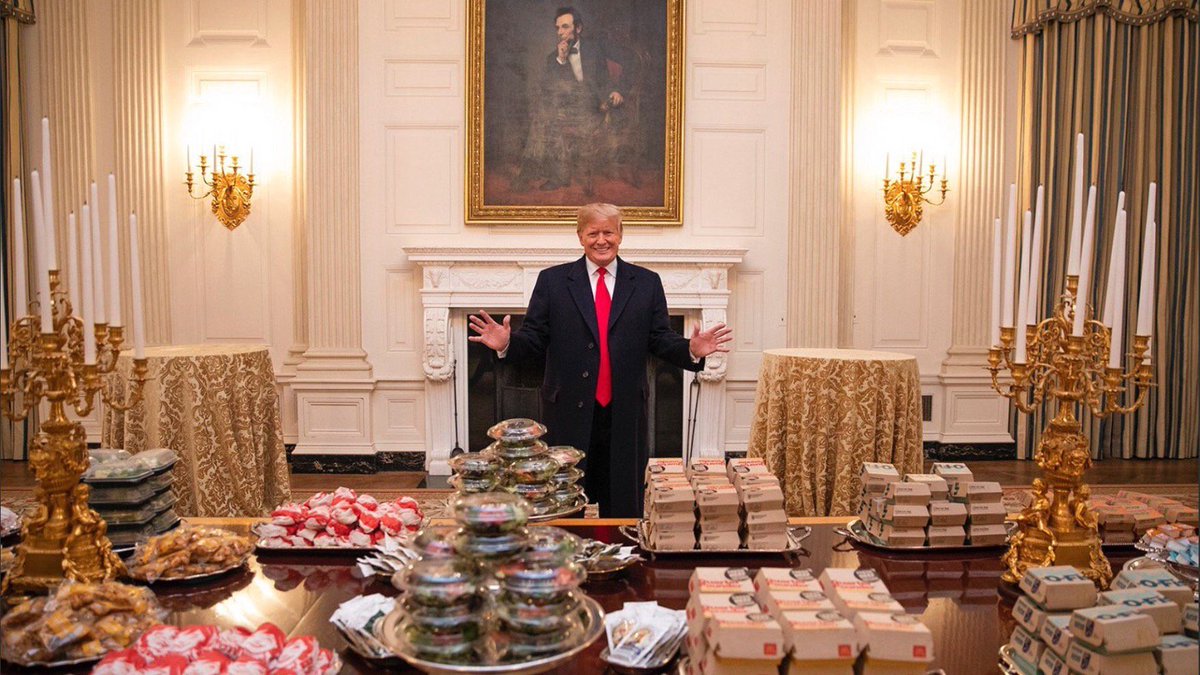
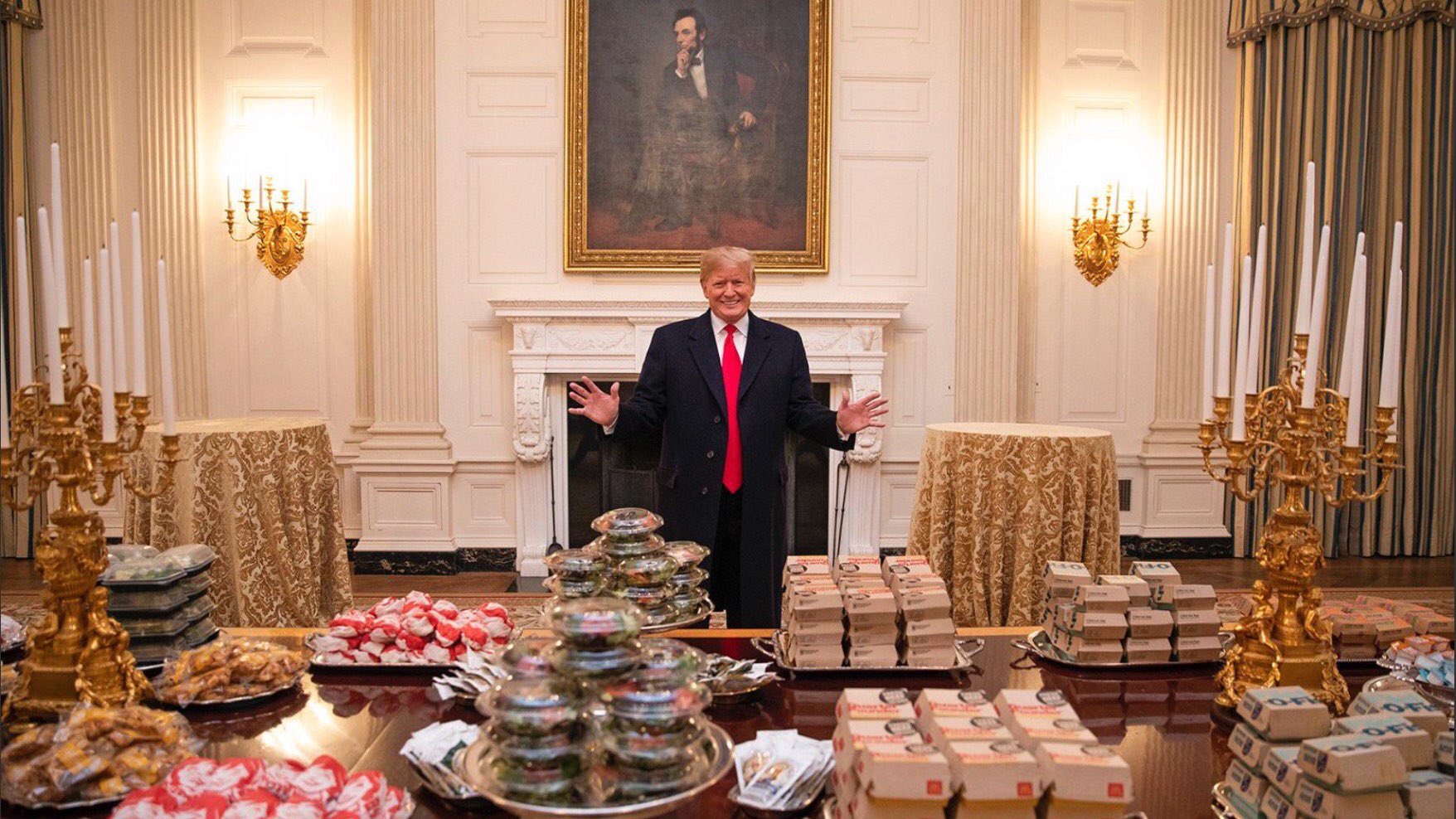
De bovenstaande foto werd genomen nadat Trump besloot hamburgers en patat te bestellen daar zijn 'kookstaf' onder de 'shut down' valt en hij dus 'zelf' voor het eten moest zorgen. Hoe passend, deze plork op de foto achter zo ongeveer het slechtste eten wat je kan vinden........

Hier wat muziek van de geweldige band PIL, ofwel Public Image Limited, met immer terecht grote kritiek op de gebeurtenissen over onze aarde. (heb een paar maanden nog een geweldig concert van deze band in het Paard gezien):